The Challenge
Best Before It's Gone sells short-dated and past-best-before food and drink — a well-established online operation with a strong following. When they decided to open a retail location at their warehouse, the stock management picture got more complicated.
The shop needed to operate independently from the main warehouse, running its own records through Sum Up Professional (their chosen EPOS). But it also needed to draw on warehouse stock when available, and not create unnecessary duplication of effort for the team.
Three specific requirements shaped the solution:
- The shop runs its own stock records independently through Sum Up
- The shop can pull from main warehouse stock but also set up shop-only lines
- Product setup in Sum Up should require fewer data points than the full ecommerce listing process
Manually keying product details into Sum Up for every item — particularly for a business handling high volumes of varied short-dated stock — wasn't going to work.
What We Built
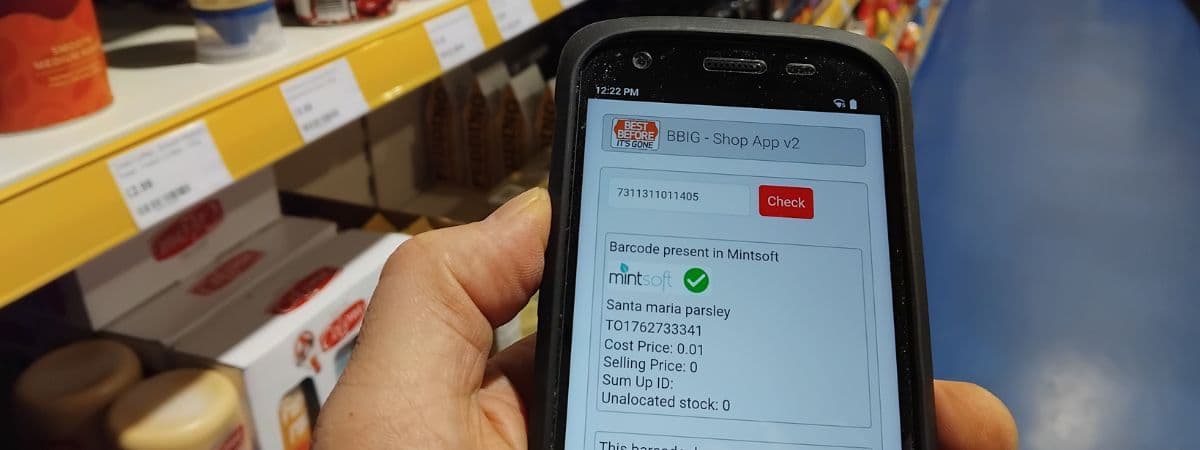
A barcode-scanning web app that does the legwork automatically. Point, scan, done.
When a product barcode is scanned, the app checks three live systems simultaneously and handles the product setup based on what it finds — no manual lookups, no duplicate data entry.
How It Works
On scanning a barcode, the app queries three API endpoints in real time:
- Mintsoft — the warehouse management system
- BigCommerce — the ecommerce platform
- Sum Up — the shop EPOS
If the product exists in Mintsoft: The SKU, item name, cost price, and selling price are pulled forward automatically and posted to Sum Up via API. If the product isn't yet listed on the ecommerce site, it's added to a to-do list via the Airtable API for the listings team to pick up later.
If the product doesn't exist anywhere: A minimal data entry form captures: name, barcode, cost price, selling price, and VAT code. An SKU is generated automatically. The product is created in Sum Up via API, added to Mintsoft (so it's in the warehouse system if it ever becomes an ecommerce line), and added to the Airtable to-do list.
Finally, the app generates shelf or pallet labels on demand — so stock can be priced and deployed to the shop floor immediately after scanning.
The Outcome
Product setup for the retail shop went from a manual, multi-screen process to a single barcode scan. The shop team can work independently without needing to involve the ecommerce or warehouse teams for every new line.
Where products already exist in the warehouse system, zero data is re-entered. Where new products are introduced, the app ensures they're captured in Mintsoft at the point of setup — meaning any future crossover to ecommerce starts from a clean record rather than from scratch.
What We Learned
When a business expands from one channel to two, the temptation is to keep them entirely separate. But a small amount of integration at the point of product setup — checking what already exists before asking for manual input — can eliminate a significant ongoing overhead.
The app is deliberately lightweight. It doesn't try to manage inventory or sync stock levels. It just removes the friction at the moment it matters most: when a new product hits the shop floor.
Visit Best Before It's Gone: cheapfood.co.uk
Facebook: facebook.com/Bestbeforeitsgone
TikTok: tiktok.com/@best_before_its_gone